
700/314 Moo 6 Bangna-Trad KM. 57, Tambon Don Hua Roh, Amphur Muang,Chonburi 20000 Thailand
An HC Meter is an instrument used to measure magnetic properties of metals, particularly magnetic induction and coercive force (Hc). These values help evaluate the microstructure and overall material quality after heat treatment or hardening processes.
Hardness testers are used to measure a material’s resistance to indentation, scratching, or deformation, providing an indication of its hardness level. At Thai Tohken Thermo, we employ four primary hardness testing methods, along with advanced analytical tools, as described below.
An optical microscope is a fundamental tool used to examine the microstructure of metallic materials. After etching or chemical treatment, it allows clear observation of phases, grain structures, and metallurgical characteristics within the material.
A spectrometer is used to analyze the chemical composition of a material. It operates on the principle of light spectrum emission or absorption generated by atoms or molecules. A detector measures the intensity of light at various wavelengths, and the resulting data is converted into a spectrum graph. This provides accurate identification and quantification of elements present in the sample.
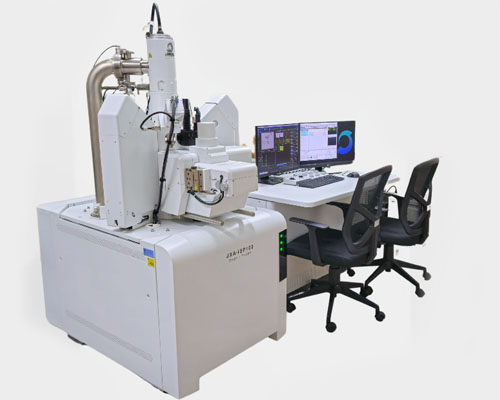
EPMA (Electron Probe Micro-Analyzer)
An EPMA is an analytical instrument that bombards the surface of a sample with a high-energy electron beam, causing the material to emit characteristic X-rays unique to each element. These X-rays are then detected to determine which elements are present and in what quantities at specific locations within the sample.
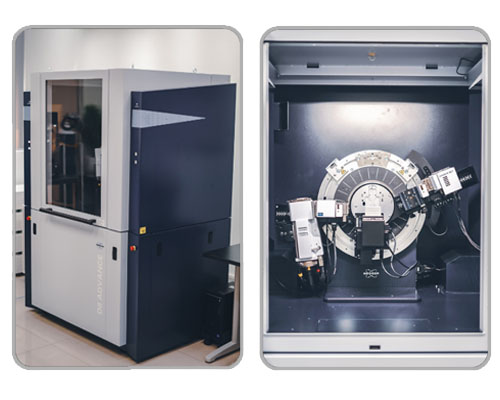
XRD (X-ray Diffractometer)
An X-ray diffractometer is used to analyze the crystal structure of materials based on Bragg’s Law. When X-rays strike atomic planes within a crystal, they are diffracted at angles equal to the incident angle, producing a unique diffraction pattern. Since each material has its own unit cell dimensions and atomic arrangements, the resulting diffraction pattern can be used for:
Phase identification
Crystal structure verification
This makes XRD an essential tool for accurate structural analysis.
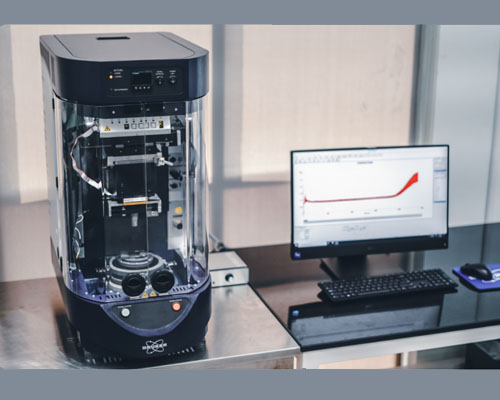
Tribology
Tribology is the study of friction, wear, and lubrication between interacting surfaces in relative motion. Its purpose is to evaluate and improve the performance of mechanical components while minimizing frictional losses and wear damage. Tribological analysis helps optimize durability, efficiency, and reliability in various industrial applications.

Dynamic Ultra Micro Hardness Tester
This instrument is designed for measuring the hardness of extremely small or thin materials—such as thin films, coatings, hardened surfaces, plastics, rubber, or semiconductors—that cannot be evaluated using conventional hardness testers.

3D Optical Profilometer
A 3D optical profilometer measures the three-dimensional surface profile of a workpiece using light or laser without contacting the surface. A beam of light is projected onto the surface, and the reflected signal is used to calculate height variations across the surface, generating a detailed 3D surface map.
It is suitable for evaluating:
Surface roughness (Ra, Rz, Sa, Sz)
Height, depth, and volume of microstructures
Detailed 3D surface topography
Coating or thin-film thickness
Wear or scratch analysis (Wear / Scratch measurement)

Ion Milling
Ion milling is a surface preparation process that uses high-energy ion or electron beams to remove material from the sample. This creates a smooth, thin surface suitable for high-resolution microscopy such as SEM (Scanning Electron Microscope) or TEM (Transmission Electron Microscope).

Electrolytic Polishing & Etching Machine
This equipment uses direct current (DC) along with an electrolyte solution to polish metal surfaces and reveal microstructures clearly. The processed samples can then be analyzed using optical or electron microscopy (e.g., OM or SEM). It is essential for preparing accurate metallurgical specimens.

Stylus Profiler
A three-dimensional (3D) surface measurement instrument capable of analyzing surface flatness in both 2D and 3D formats. The system can also be integrated with tribology equipment for advanced surface analysis applications.
It is a high-precision measuring instrument designed to evaluate surface roughness and step height of workpieces. The measurement is performed using a stylus probe that traces across the surface of the specimen, enabling accurate analysis of surface characteristics.

Raman Spectrometer
Raman Spectrometer is a non-destructive chemical analysis technique that provides detailed information about chemical structure through the interaction of light with chemical bonds within a material. It is a light-scattering technique that reveals both structural and chemical identity information. Large spectral databases containing thousands of spectra can be searched rapidly to find matches with the substance being analyzed, including contaminants and impurities.
No WhatsApp Number Found!
WhatsApp us